
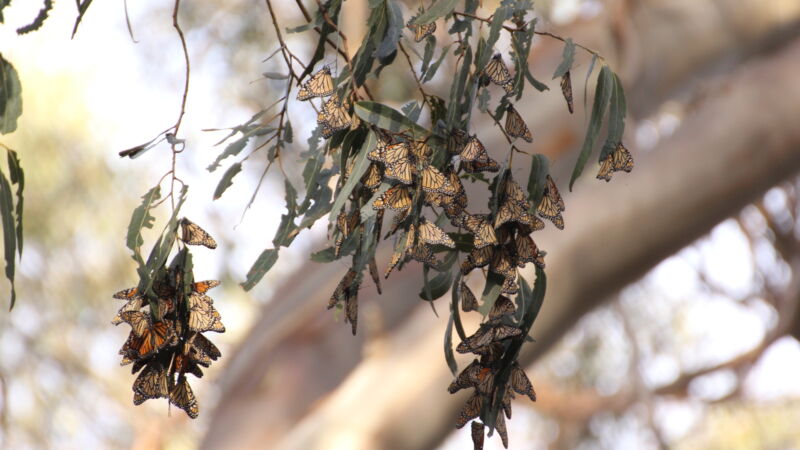
Results from the 29th annual Western Monarch Count, led by The Xerces Society for Invertebrate Conservation, have arrived.
Each year, volunteers and conservation organizations conduct surveys at overwintering sites along the California coast from Mendocino County to Northern Baja, Mexico, as well as known inland sites in California and Arizona. From late November through early December 2025, hundreds of volunteers and partners participated in the effort, surveying 249 overwintering sites and recording a peak population of just 12,260 monarchs. While this is an increase from last season's 9,119, it is the third-lowest tally since the count began in 1997.
Habitat availability, habitat quality, temperature, and rainfall patterns can affect the number of overwintering monarchs. For more details about the 2025 season count, read The Xerces Society’s announcement by clicking here (read in Spanish here).
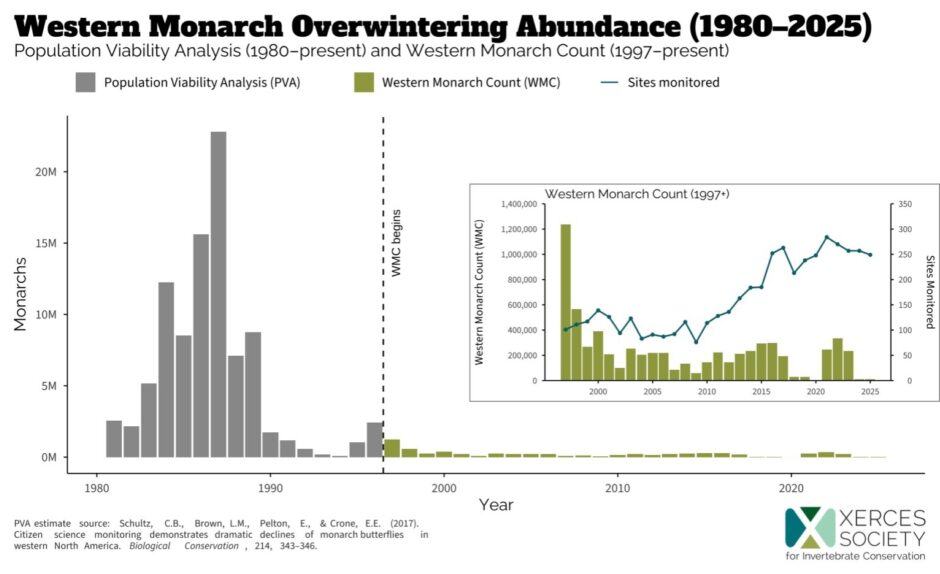
Researchers believe that in the 1980s, more than 4.5 million monarch butterflies spent the winter in California (Schultz et al. 2017). While we don’t know the precise threshold to ensure the western migration survives, Schultz et al. (2017) suggest that at least 30,000 butterflies are needed to sustain the migration. Continuing population declines underscore the need for conservation efforts that support monarchs throughout their life cycle. Key conservation strategies include:
Create habitat- The Xerces Society recommends against planting milkweed within a mile of monarch overwintering grounds and in areas where milkweed did not historically occur, like high-elevation forests, but everyone can help create habitat by planting flowers that grow throughout the year. Find more information on where to locate native milkweeds and other native wildflowers to support monarchs and other pollinators on our Milkweed Vendor Map.
- Participate in Community Science Programs- Learn more about community science programs in your area. Please note that the states of California and Washington require that you have a scientific collection permit to handle monarchs in these states.
In Canada, California, and Washington, special regulations may restrict monarch handling. Always check local and federal laws before collecting or rearing monarchs. In Washington, “it is unlawful to collect ... wildlife or their nests and/or eggs for the purpose of research or display without first obtaining a Washington state scientific collection permit.” California requires “permits for the take or possession of wildlife, including ... invertebrates for scientific, educational, and propagation purposes.”
Educate others about monarchs and pollinators, and how they can help. Share information with others through social media and in person to raise awareness for habitat and pollinator conservation. One action can lead to another, and the more knowledgeable and passionate people are about these species’ conservation, the better.
Limit or eliminate pesticide use that may cause unintended harm to monarchs and other beneficial insects.
Learn more about Monarch Joint Venture’s California Programs- MJV staff are advancing research, educating communities, and building relationships and partnerships to protect the western monarch population and to restore biodiversity and ecological resilience across the western landscape.
The Monarch Joint Venture thanks the Xerces Society for coordinating the Western Monarch Count, volunteers who took part in this year’s effort, MJV’s Monarchs and More Western Habitat Program participants, and everyone else who made an effort to help monarchs and other pollinators this year. Whether you contributed to a community science effort, created habitat on your property, or advocated for wildlife in any way, from anywhere in the monarch’s range, your actions make a difference.
These actions add up. Together, we can help sustain the monarch migration and conserve other plants and animals that share their habitats.