
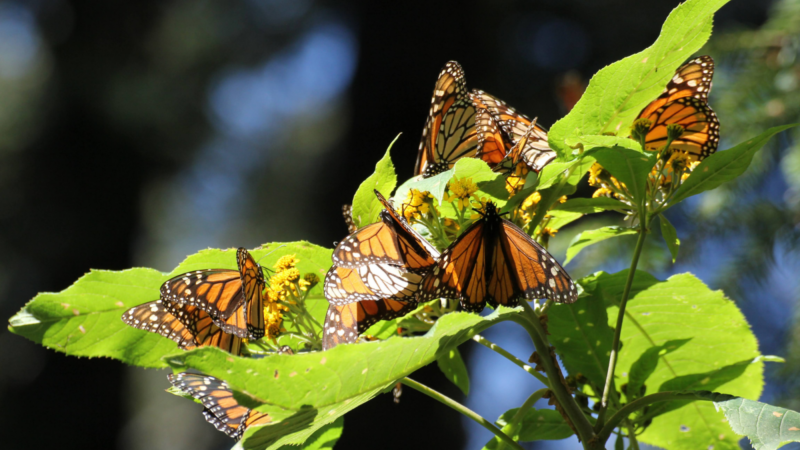
Photo Credit: © Wendy Caldwell
Media Contact: Wendy Caldwell, Executive Director, wcaldwell@monarchjointventure.org
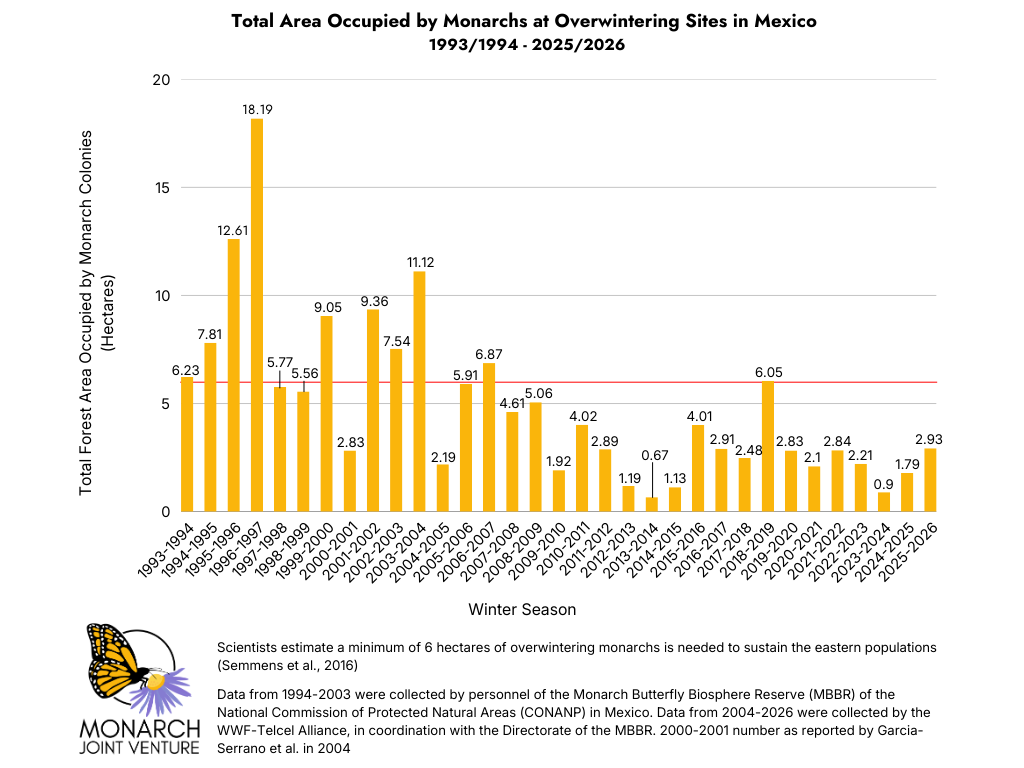
The eastern monarch butterfly population overwintering in Mexico’s oyamel fir forests occupied 2.93 hectares during the 2025-2026 overwintering season, according to the latest survey released by the World Wildlife Fund–Telmex Telcel Foundation Alliance (WWF) and Mexico’s National Commission of Protected Natural Areas (CONANP). This represents about a 64% increase compared to last year’s estimate of 1.79 hectares.
Each winter, researchers survey monarchs while they cluster together at their overwintering sites in central Mexico. Rather than counting individual butterflies, scientists estimate population size by measuring the total area of trees occupied by monarch clusters. One hectare equals approximately 2.47 acres, or just over two American football fields. Although the number of monarchs per hectare varies by year and site, estimates suggest roughly 20–30 million monarchs per hectare, with a median estimate of 21.1 million (Thogmartin et al., 2017).
This winter, there were nine colonies of monarch butterflies – three in Michoacán and six in Estado de México. Five colonies were located inside of the Monarch Butterfly Biosphere Reserve (MBBR), occupying 5.61 acres of forest, and four were located outside of the MBBR, occupying 1.63 acres. The colony of Atlautla, outside of the monarch region, occupied 0.005 acres of forest.
The eastern monarch population remains below levels considered necessary for long-term sustainability, although this year’s improvements are encouraging. Research suggests that at least 6 hectares of occupied overwintering habitat are needed to support a stable eastern migratory population (Semmens et al., 2016).
Why monarch numbers fluctuate
Year-to-year changes in monarch abundance reflect the complex and dynamic nature of their annual life cycle. Population size depends on conditions across the entire migratory range, including the availability of milkweed and nectar plants during the breeding season, weather conditions along the migration route, and habitat quality at overwintering sites. Favorable conditions in one stage of the cycle cannot fully offset challenges in another.
Conditions during the 2025 breeding season were more favorable for monarchs than in 2024, Dr. Karen Oberhauser wrote in an update for Journey North, a community science program of the Monarch Joint Venture. You can read her analysis of this year's numbers here.
Regardless of short-term fluctuations, monarchs continue to face persistent stressors. Habitat loss across agricultural, urban, and transportation landscapes has reduced the availability of breeding and migratory resources. Extreme weather events, changing climate conditions, and pesticide exposure further affect survival and reproductive success. Monarchs are also affected by predators, parasites, and disease, which can vary regionally and annually.
Monarch conservation moving forward
Concerns about long-term declines in monarch populations have prompted an ongoing review under the Endangered Species Act. After a petition to list the monarch butterfly was submitted in 2014, the U.S. Fish and Wildlife Service (USFWS) determined in 2020 that listing was warranted but precluded, placing the species on the candidate list. In December 2024, the USFWS published a proposed rule to list the monarch as threatened, accompanied by a proposed 4(d) rule and critical habitat designation, and in September 2025, moved the rulemaking to a “long-term action” designation in the Unified Agenda, indicating additional time is needed before a final determination. While monarchs are not yet listed, these actions reflect concerns about long-term population stability and the cumulative effects of multiple threats.
Regardless of regulatory outcomes or short-term population changes, sustained, voluntary conservation efforts across the monarch’s breeding, migratory, and overwintering range remain essential. The Monarch Joint Venture advances these efforts through science-based conservation focused on habitat, science, education, and partnerships, guided by the Monarch Conservation Implementation Framework. With more than 135 partners, including agencies, nonprofits, businesses, and academic institutions, MJV facilitates collaboration, information sharing, and conservation planning to support monarch recovery and safeguard the migration for future generations.
How you can help
Create habitat for monarchs – Monarchs cannot survive without an abundant supply of milkweed: plant native milkweed and nectar-rich flowers to support monarchs throughout their life cycle.
Participate in community science – Help researchers track monarch populations, migration patterns, and health by contributing to community science projects.
Share information – Share your knowledge with others so they, too, can enjoy monarchs and help conserve the migration.
Advocate – Speak up for what you care about.
Donate – Nonprofit organizations like the MJV depend on donations and grants to continue their critical work in monarch and wildlife conservation. You can support these efforts in many ways, including shopping at our store, making monthly contributions, sponsoring programs, and more.
Resources
2025 Monitoreo Mariposa Monarca en México 2025-2026 (PDF)
Area of Forest Occupied by Monarch Butterfly during the Winter 2025-2026 (PDF)
Forest Degradation in the Core Zone of the MBBR 2024-2025 (PDF)
Monitoreo Forestal en la zona núcleo de la RBMM 2024-2025 (PDF)
Download the 1993/1994 - 2025/2026 Eastern Overwintering Monarch Population Graph